
This website provides only general lifestyle information and does not constitute professional or medical advice.
Overview

Relaxation practices that fit into real evenings

Here you will find a structured overview of methods we cover in more detail across the site. Every practice has its own character — and its own audience. Take your time choosing.

The main methods

Four practices that are simple to try

These four approaches are well documented, everyday-friendly, and require no extra equipment. They are especially fitting when you want to round off the day and turn the volume of the thought carousel down a notch.

Body scan

You travel in your awareness from your toes to the crown of your head, noticing what you notice — without trying to change anything. This passive attention is a counterpoint to the analytic daytime mode and takes 10 to 20 minutes. Particularly suitable when your body feels "tight" but you cannot pinpoint where.
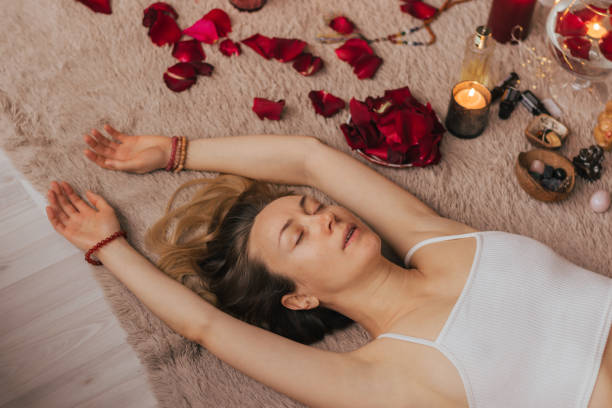
Progressive muscle relaxation

You consciously tense muscle groups one after another for 5 to 7 seconds, then completely let go. The contrast makes "letting go" tangible and therefore easier to repeat. A tried Jacobson method that also works when your thoughts keep spinning — because it is physically engaging enough to hold your focus.

Evening journaling

Three short notes about the day, one thing you would like to let go of, and one open topic that may wait until tomorrow. This "cognitive offloading" eases working memory. Just 5 minutes are enough, and it is one of the few practices that also works in bed if you cannot fall asleep.

Gentle evening yoga

A few quiet asanas like child's pose, supine twist, or legs-up-the-wall. No sweating, no momentum — only soft lengthening. This form activates the parasympathetic nervous system and is ideal for people who go to bed physically stiff after long days of sitting.

Quiet bedroom with warm lighting and soft textiles
Setting matters

Practices work better inside the right frame

A quiet room, dimmed light, and a conscious pause before the exercise strengthen the effect of the chosen method. You do not need to make anything perfect — even small changes to the surroundings send signals.

Health & Safety Guidelines

Friendly notes for a comfortable practice

Relaxation practices are usually very gentle on the body. These notes are general comfort tips so your evening stays pleasant and unhurried — they are not medical advice and they do not address any specific personal situation.

Listen to your body

Relaxation exercises are designed to feel pleasant. If anything does not feel right during a practice, simply stop and take a normal break. For any ongoing personal concerns, a conversation with a qualified professional you already trust is always a sensible step.

Begin breathing techniques gently

Start with short sessions of two to three minutes. If a rhythm feels too intense for the moment, return to your everyday breathing and choose a shorter version next time. There is nothing to gain from pushing through discomfort.

Pace yourself with new exercises

When you are new to breath-based or movement-based practices, start at the easiest level and add intensity only when the basics feel familiar. A slow on-ramp is the most reliable way to build a routine that actually lasts.

Some evenings, less is more

Long silent practices are not always the right choice on a given day. If your mind feels especially busy, a short guided audio or a gentle walk can be a kinder option. Pick the form that matches your evening rather than forcing a fixed plan.

Choose formats that fit your situation

If your personal circumstances suggest that a particular exercise may not be suitable for you right now, choose a gentler alternative. When in doubt, a qualified professional you already work with is the best person to ask what formats fit your context.

Make the surroundings friendly

Aim for a comfortable room temperature, a soft surface, and clear airways. Move tripping hazards aside, keep a blanket close — that protects you from unnecessary interruptions and lets you focus on the practice itself.

In practice

One practice from start to finish

To give you an idea of what a simple session looks like, here is a 4-step example for a classic body scan at home.

Set up your position

Lie on your back, a blanket under your head, a second one over your ankles. Arms relaxed beside your body, palms facing up. Close your eyes or look softly at the ceiling. Keep the airways clear, the shoulders loose.

Set the anchor

Feel three deliberate breaths. A long exhale, without forcing it. The goal is not to press yourself deeper into the floor but simply to notice that you are in contact at all.

Let attention travel

Start at the feet and move upward in small steps: lower legs, knees, thighs, pelvis, abdomen, chest, shoulders, arms, neck, face, scalp. About 30 to 60 seconds per region. Simply notice — do not try to improve anything.

Close out

Feel the whole body as one again. If you like, say to yourself "my day is done now." Roll onto your side, exhale once, open your eyes slowly. The exercise is over.

A practice does not need to "change" you. It is allowed to simply accompany you — quietly, regularly, without expectations. That is exactly where it shows its quietest effect.
— From our editorial notes